
You Cannot Harvest What You Have Not Planted: What Boards Owe Their Organisations

Aktualisiert: 25. Aug.

Who steps in if your CEO doesn't show up tomorrow? If you had to think about it – how long did it take you to answer?
That hesitation usually means one thing: there is a plan, but not readiness. You cannot harvest what you have not planted.
Every board faces this moment: A CEO departure, planned or otherwise. Suddenly a question that should have been building for years has to be answered in weeks. In those moments, the quality of the groundwork done beforehand becomes immediately visible.
Some boards find themselves with real options: assessed candidates, a clear process, a bench that has been developed with intention. Others find themselves with a list of names that nobody has seriously evaluated, a slide deck from eighteen months ago, and a decision that feels more like a crisis than a transition.
This piece is about building the first kind of readiness and about sowing the necessary seeds to make sure you will be able to reap the results.
The Governing Principle: Readiness
Before getting into the how, one principle matters more than any process or framework.
Succession planning is not an event. It is a permanent state of readiness.
The organisations that manage succession well do not necessarily have more sophisticated processes than everyone else. They have a different relationship with the question. Succession readiness is something they maintain continuously, the way a well-run organisation maintains its financial health. It is never finished. In fact, the most useful way to think about it is that succession planning renews itself the day a new successor takes over. The moment the appointment is made, the work toward the one after begins.
Succession planning is not a one-time event. It is an ongoing, strategic process that ensures leadership continuity. Though hard to execute, it is best conceived as a progression that renews itself the day a new successor takes over.
The practical implication is that succession needs to be a standing item on the board agenda, reviewed with real substance at least three or four times a year, not an annual exercise that produces a slide deck and a sense of having handled it.
The chair carries primary responsibility for keeping it there. The most effective chairs make this explicit from the moment they begin working with a new CEO: we will discuss succession planning regularly, it will never come as a surprise, and it is simply what good governance looks like. That framing removes the political charge from the conversation, which is the only way to have it with the depth it deserves.
The best boards plan for a harvest they won't personally reap.
And the best boards plan for a harvest they won't personally reap. Succession planning done properly rarely benefits the directors who do it. By the time a well-prepared successor steps into the role, the supervisory board members who insisted on building the pipeline may have rotated off, term limits reached, priorities moved elsewhere. That's precisely what makes it a test of governance discipline rather than self-interest. It's easy to mobilize a board around a crisis that threatens the current term. It's much harder to mobilize one around a transition that will happen on someone else's watch.
Three Successions, Not One
Most boards think of succession as a single question: who succeeds the CEO? That is the most important question, but it is not the only one.
A board has three distinct succession obligations.
1. CEO succession
The board's most consequential responsibility, and the one that receives the most attention. It still, consistently, often receives less rigorous attention than it deserves.
2. C-suite succession
The leadership roles reporting to the CEO, and the critical functional leaders beneath them. A sudden departure at CFO, CTO, or COO level can be as damaging as a poorly managed CEO transition, and yet most boards have limited visibility into the readiness of those pipelines.
A useful discipline: for each of the organisation's top fifteen roles, the board should be able to answer clearly: if this person were not here tomorrow morning, what would we do? In most organisations, that question cannot be answered with confidence for more than a handful of roles.
3. Board succession
The most neglected, and in some ways the most fundamental, is the board succession itself.
The most neglected, and in some ways the most fundamental, is the board succession itself.
Board succession is not about filling an empty seat. It is about constructing a board.
Filling a seat is reactive: it starts from a vacancy. Constructing a board starts from a forward-looking view of what the organisation needs around the table to govern effectively through its next strategic phase, identifies the gaps between that need and current composition, and recruits proactively to close those gaps before vacancies arise. Most boards still approach their own succession as the former. The best approach it as the latter. (If you would like to read more, I have written about this in Building a Board is not a Hiring Decision. It's a Design Decision.).
All three require active management. The succession planning conversation that covers only CEO succession is covering perhaps a third of the board’s actual responsibility.
Where the Work Starts: The Future Leadership Profile
When boards do engage seriously with CEO succession, they often start in the wrong place. They start with candidates. Who do we have internally? Who could do this job?
The right starting point is not candidates. It is a forward-looking leadership profile.
The question is not who could fill this role as it currently exists. The question is: what kind of leader will this organisation need over the next strategic phase, what challenges will they face, and what capabilities will be required to navigate them successfully?
That question, answered honestly and in detail, produces a profile that becomes the benchmark against which both internal and external candidates can be assessed. It requires the board and the current CEO to have a real conversation about where the business is going, what is likely to get harder, and what kind of leadership strengths will matter most in that context.
Critically, it requires the board to distinguish between the capabilities that made the current CEO successful and the capabilities the next one will need. These are related but rarely identical. A CEO who led the organisation through rapid growth may have been exactly right for that phase. The capabilities required to navigate the transformation or repositioning that follows may be quite different.
The profile should address four dimensions:
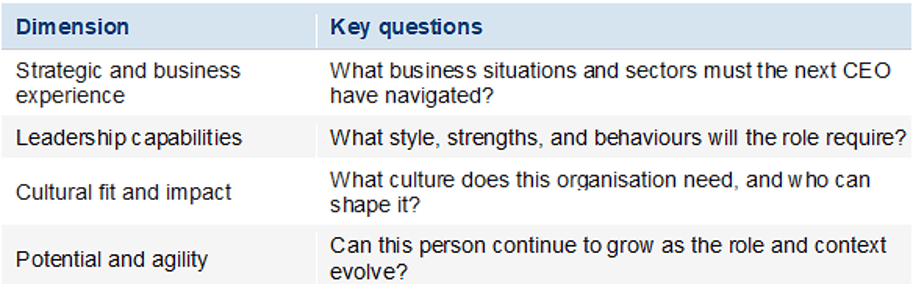
Getting alignment on all four, before any names are discussed, is what separates a serious succession process from an informal conversation that gravitates toward whoever is most familiar.
Building the Pipeline: You Cannot Harvest What You Have Not Planted
The most important insight in succession planning, and the one most consistently underacted on, is that developing leaders takes years. Not months. Years. You cannot harvest what you have not planted.
You cannot harvest what you have not planted.
The time to invest in potential successors is not when a transition is approaching. It is long before, when there is no immediate pressure and the development work can be done properly. This is what makes succession planning a continuous process rather than a periodic one. The development has to happen before the pressure arrives, when there is still time to do it properly.
The time to invest in potential successors is not when a transition is approaching. It is long before.
What does that development actually look like?
Start earlier and look deeper than feels necessary.
The obvious candidates at the level directly below the CEO are the natural starting point, but effective succession processes look further. Some of the strongest successors are found not among the most senior executives, but among high-potential leaders one or two levels further down: people with the raw capability and growth trajectory to be ready in three to five years with the right investment. Finding those people early enough to develop them properly is one of the most valuable things a board can do.
Invest in real stretch, not just observation.
The most effective leadership development comes from real challenge: assignments that push leaders beyond their current comfort zone, cross-functional exposure that builds a whole-organisation perspective, and meaningful interactions with the board that go beyond formal presentations. A potential CEO successor who has only ever presented to the board in a formal setting is being observed, not developed. Observation is not development.
Manage talent as an enterprise asset, not a functional one.
Rather than managing succession as a series of individual contests for specific roles, the most effective organisations build enterprise talent pools of their highest-potential leaders, managed at CEO and CHRO level rather than siloed within functions. Those individuals get visibility, mobility, and development across the organisation. The result is a bench that is deeper, more resilient, and less vulnerable to the departure of any single individual.
The time to build relationships with potential future leaders is exactly when you do not need them immediately. Wait until there is an urgent need, and you may find yourself with limited and expensive options.
The Time Horizon: Three Different Situations
One of the most useful things a board can do is think about succession across three distinct time horizons, because the right actions differ significantly depending on how much runway is available.
Three or more years: Build and develop
This is the right situation to be in, and the one most boards should be operating from if they are managing succession as a continuous responsibility.
With this much time, the priority is developing internal candidates properly. The future leadership profile has been built. High-potential leaders have been identified at multiple levels. Development plans are in place and actively tracked. The board has deep familiarity with the internal bench through regular exposure, not just formal presentations.
External benchmarking matters here too, not because an external hire is planned, but because internal candidates are better assessed when there is a current picture of what the strongest external alternatives look like. That comparative lens prevents the systematic overrating of familiar faces, one consistent failure mode in succession planning.
One to two years: Assess and compare
The horizon has shortened and the intensity increases.
Internal candidates should by now have been formally assessed against the future leadership profile: rigorously evaluated against agreed criteria rather than simply observed by people who know them well. Gaps should have been identified and development plans adjusted.
The board should now be actively mapping the external market, understanding who the strongest candidates are and how they compare to the internal slate. This does not mean launching a search, but it means doing enough groundwork that a search could begin quickly if needed.
This is also the period in which the first difficult decisions need to be made about internal candidates who are most likely not going to be selected. How those conversations are handled, with honesty, care, and genuine attention to retention, determines whether the organisation keeps or loses the talented people it has invested in developing.
Imminent or emergency: Act with what you have
This is where the absence of earlier work becomes most costly.
For emergency succession, every board should have a clear, current answer to a simple question: if the CEO were unable to perform their role starting tomorrow, who would step in, and for how long?
This should not be a theoretical answer on a document. The interim candidate should be aware of the possibility, have a solid understanding of key stakeholder relationships and strategic priorities, and have a relationship with the board that would allow them to function credibly in the role from day one.
The absence of this clarity is not a minor governance gap. It is a significant and preventable organisational risks at the hands of a board.
Internal or External? Some Thoughts for the Decision
Every succession process arrives at the same fork. And it is one of the decisions where boards are most susceptible to systematic bias, almost always in favour of the internal candidate, for reasons that have more to do with comfort than with strategic fit.
Here is a framework for thinking it through.
When internal succession tends to be the stronger choice
The organisation's strategic direction is largely continuous, requiring evolution rather than transformation
There is a well-prepared internal candidate who has been developed against the future leadership profile, not just the current one
Cultural continuity is critical and the internal candidate embodies and can build on that culture
Stakeholder confidence depends on continuity signals, for example in a family business or a regulated environment
The organisation needs to send a powerful retention message to the leadership layers below
The important caveat:
Internal succession only delivers these benefits when the candidate is truly ready. Familiarity is not readiness. The board's confidence in someone they have known for years is real, but it is not the same as a rigorous assessment of whether that person can perform a more demanding job in a different context.
When external succession tends to be the stronger choice
The organisation needs a significant shift in strategy, culture, or operating model that an insider cannot credibly lead
The internal bench is unprepared, and waiting for development would create more risk than going external
The organisation has reached a new phase, for example from private to public, from national to international, or from founder-led to professionally managed, that requires capabilities that do not yet exist internally
Fresh external perspective is needed to break entrenched patterns or challenge assumptions that insiders take for granted
A credibility signal to external stakeholders requires a profile that cannot be met from within
Important: Be Clear on the Criteria
Evaluate internal and external candidates against identical criteria. The same future leadership profile. The same rigorous assessment. The same honest evaluation of gaps, and the same willingness to conclude that a gap is disqualifying rather than just developmental.
Internal candidates do not earn an easier process because they are familiar. They earn the appointment by meeting the same standard.
Internal candidates earn the appointment by meeting the same standard.

Internal transition - consistently underestimated
When an internal candidate is appointed, the transition work does not end at the announcement. Internal promotions require just as much structured onboarding, coaching, and board support as external hires, often more. Prior relationships, established expectations, and old dynamics need to be actively managed rather than left to sort themselves out.
The Conversation the Board Is Not Having
There is an unspoken agreement in many board-CEO relationships not to discuss succession directly. The board does not want to seem as though it is planning for the CEO's exit. The CEO does not want to signal that they are already thinking about leaving. And so the conversation happens at a surface level, mentioned in governance documents and annual reviews, without the honesty it deserves.
There is an unspoken agreement in many board-CEO relationships not to discuss succession directly.
This avoidance is expensive. Not just in the quality of the eventual transition, but in the ongoing quality of succession planning itself. A board that cannot talk directly with its CEO about succession cannot get the CEO's honest assessment of internal talent, cannot enlist the CEO as an active developer of potential successors, and cannot benefit from the CEO's unique knowledge of the organisation's leadership bench.
The chairs who handle this best make succession a normal part of the conversation from day one. Not a threat. Not a performance evaluation. Simply part of what good governance looks like.
When that framing lands, the succession conversation shifts from a politically charged subject that everyone would rather avoid to a shared strategic endeavour. A CEO who is genuinely invested in building the bench, rather than protecting their position, demonstrates the kind of institutional commitment that defines leadership at the highest level.
What Good Looks Like In Practice
Pulling all this together, the boards that consistently handle succession well share a set of recognisable characteristics.
On process and cadence:
Succession is a standing board agenda item, reviewed substantively at least three to four times a year
The future leadership profile is developed early, reviewed annually, and updated as strategy evolves
Emergency succession clarity exists and is tested: the board can answer the “tomorrow morning” question without deliberation
On talent development:
High-potential leaders are identified early and broadly, not just at the most obvious levels
Internal talent has genuine board visibility through real interactions, not just formal presentations
Development is real: stretch assignments, cross-functional exposure, structured feedback
Enterprise talent pools are managed at the top of the organisation, not siloed by function
On market awareness:
The external market is monitored continuously, not just when a search is about to begin
The board has a current picture of the strongest external alternatives for its most critical roles
On board succession:
Board composition is reviewed against forward-looking strategic needs, not just current requirements
Skills gaps are identified and proactively recruited against, before vacancies arise
Director tenure is managed thoughtfully, with honest conversations about renewal
Harvest What You Have Planted
There is a question I find useful in any succession conversation. Not who should succeed the current leader, but: what would a board that is truly confident in its succession readiness look like right now?
That question tends to produce a more honest assessment than asking whether a succession plan exists. Plans can exist without readiness. Readiness is harder to fake, and harder to build in a hurry.
The organisations that build it consistently are the ones that find themselves with real choices when the moment comes. They can act from a position of strength rather than scrambling from exposure.
Succession planning is not about finding the safest option. It is about finding the right leader for what is coming next.
That distinction sounds simple. Getting it right, consistently, over time, is one of the most demanding things a board does. It also makes sure that you will be able to harvest what you have planted.
That is what I believe good governance at the top looks like.
Photo credit: Anton Maksimov
ABOUT THE AUTHOR
Marion Heil is founder and managing partner of Board+CEO Advisors, a Vienna-based high-end executive search and board advisory boutique. She advises listed companies, family businesses and investors on C-suite, leaders and supervisory board appointments and succession mandates across DACH and EMEA.


